Woodworking tools are the core of my workshop. They perform of a lot of my work, and I've built most of my shop with them.
Table saws
The physical center of the shop is a combined tablesaw and router table. An ordinary Craftsman 10" bench saw shares a stand with a 4" Proxxon saw that I've equipped with a full width ball bearing sliding top and a router table with a half width plain bearing sliding top. The Craftsman is set up for ripping with a low fence, while the Proxxon is set up for cross cutting, using a magnetic indicator base to set the width of the cut.
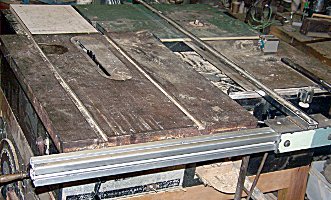
Clockwise from top right: router table, sliding table saw, rip saw
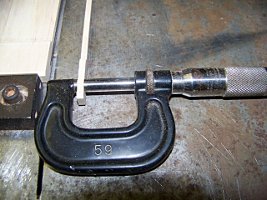
Sawing parts to close tolerances
Drill presses
I have two dedicated drill presses, down from five, and two machines that can be quickly set up for drilling. Each one has somewhat different capabilities.
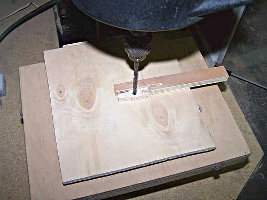
Chickering hammer flange fixture on my old drill press
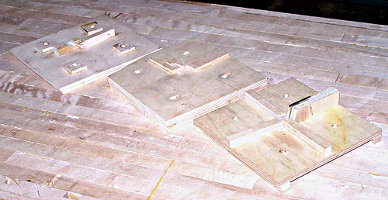
Drilling fixtures
I drill action parts using fixtures indexed to an auxiliary table on my only general purpose machine, an imported 14” bench drill. I made an adapter for it to take the overarm mounted Unimat vertical head for my Atlas mill in order to be able to use small solid carbide bits, with more than three times its maximum speed.
The Unimat head tilts side to side for simple angle drilling, somewhat like the table of an ordinary drill press. I also built a radial drill for drilling compound angles. The angle of the head adjusts in two axes at the end of a ram that adjusts from 6 to 57 inches from the column, and elevates the spindle nose from about 4 to 12 inches from the base. I use it to drill keyboards, action rails, bridges and pinblocks.
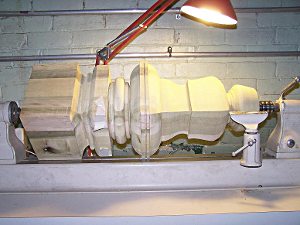
Reproduction leg for a Sohmer grand turned on my Delta lathe
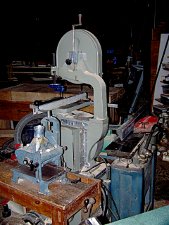
Planer, bandsaw and jointer
Wood lathe
I built a special bench for my grandfather's old 12” Delta wood lathe. It has a built-in dust chute, and I added a parallel motion arm with a small router behind it for cutting reeds and flutes. A horizontal spindle allows very fine details in turnings in difficult wood.
Stock preparation
I have a 14” bandsaw equipped with Laguna ceramic guides, mostly for resawing the relatively small lumber I use. It's arranged in a unit with my grandfather's 6” jointer and little 6” Herbert open- sided planer. This arrangement reduces movement of heavy stock and simplifies ductwork for dust collection.